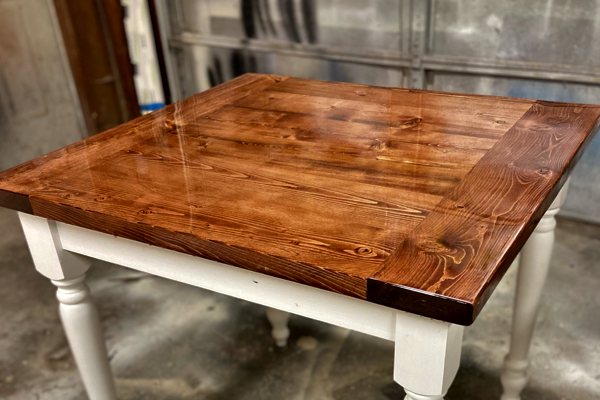
Selecting the right sealant is critical for protecting your table top from damage and ensuring a safe, hygienic surface. One of the best options is to coat it your table with a high-quality epoxy resins, which will lock out moisture, prevent bacterial growth, and create a durable barrier against daily wear.
Below, we’ll explore why sealants matter, why you should spring for a premium epoxy, and practical tips for beginners.

Why Table Top Sealants Matter
A sealant serves as your table’s first line of defense, offering:
-
Protection Against Moisture & Stains: Food and drink spills can penetrate unsealed wood, causing warping or mold. A non-porous epoxy coat repels liquids instantly.
-
Scratch & Impact Resistance: Everyday use—dishes, keys, gadgets—inevitably scratches. Epoxy’s hard surface resists abrasion and dents.
-
Health & Hygiene: Sealed surfaces don’t harbor bacteria or allergens. A smooth, seamless epoxy finish is easy to disinfect.
-
UV & Chemical Shielding: Proper sealants block UV rays that yellow wood and resist common household cleaners, reducing discoloration and breakdown.

Understanding Table Top Wear and Tear
Table tops face a variety of stresses:
-
Physical Impact: Dropped items—heavy or sharp—can leave behind permanent damage to a table top with a weak finish or no finish at all.
-
Chemical Exposure: Citrus juices, alcohol, and cleaners can etch or stain soft sealants.
-
Mechanical Abrasion: Utensils, plates, and décor items drag across the surface daily.
-
UV Fading: Sunlight breaks down inferior coatings, leading to yellowing or chalky surfaces.
A quality epoxy resin addresses each of these challenges with a tough, clear barrier.

Why Epoxy Outperforms Other Sealants
Compared to varnish, polyurethane, lacquer, shellac, or hardwax oil, epoxy delivers:
-
Thickness & Depth: Epoxy is easily applied by pouring it in thick layers of 1/8" to 2″, filling cracks and creating a seamless top.
-
Self-Leveling Finish: Unlike brush-on coatings, epoxy flows into a perfectly flat surface without brush marks.
-
Superior Hardness: UltraClear Epoxy cures to a 98+ on the Shore hardness scale—far beyond varnishes.
-
Stain & Chemical Resistance: A cured epoxy surface resists wine, oil, and cleaning chemicals without dulling.
-
Hygienic Non-Porosity: No microscopic pores means bacteria and mold have nowhere to hide. An epoxy surface is easy to clean and sanitize.


The Pitfalls of Budget-Brand Epoxies
These days, there are many brands of epoxy available to aspiring users; some are high in quality, but many are not. Low-cost, imported epoxies—often called budget-brand epoxy—seem cheaper at first but often consist of substandard resin that can exhibit a variety of flaws during use, such as:
-
Yellowing & Cloudiness: Lack of UV inhibitors leads to a dull, amber tint within months.
-
Soft or Brittle Cures: Poor resin-to-hardener ratios can result in tacky spots or cracking under stress.
-
Excessive Bubbles: Substandard formulations trap air that won’t release, leaving pinholes.
-
Inconsistent Quality: Batch-to-batch variability causes unpredictable curing times and performance.
These defects not only shorten the lifespan of your table but can be a maintenance headache and even hazardous. So, not only is it more cost efficient in the long term to use high-quality epoxy upfront, but it's also safer.


The UltraClear Epoxy Difference
For a comfortable, worry-free epoxy experience, choose UltraClear Epoxy:
-
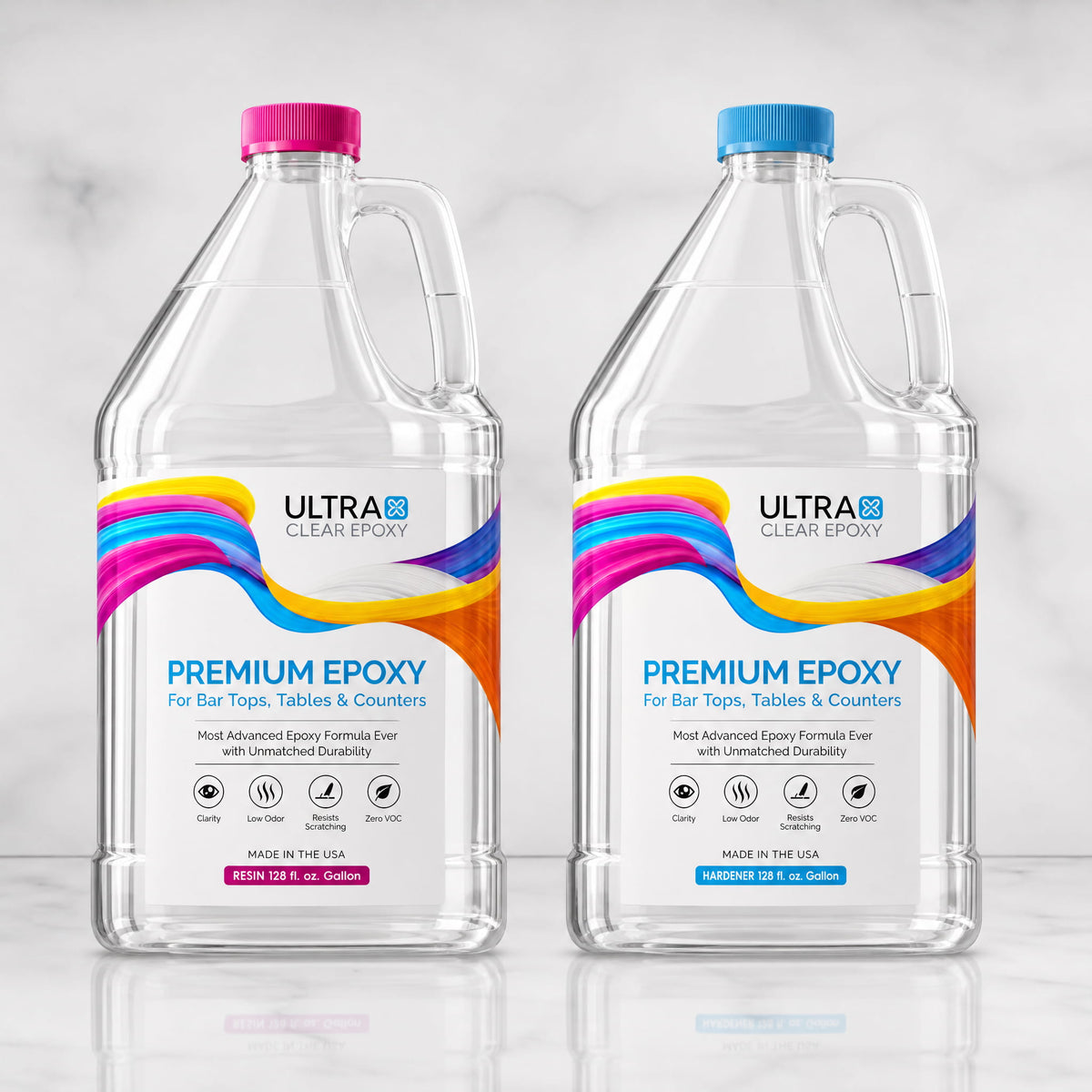
UltraClear Bar & Table Top Epoxy—Designed for 1/8″–1/4″ thickness, self-leveling and bubble-resistant; this is our strongest resin and cures to a crystal-clear finish.
-
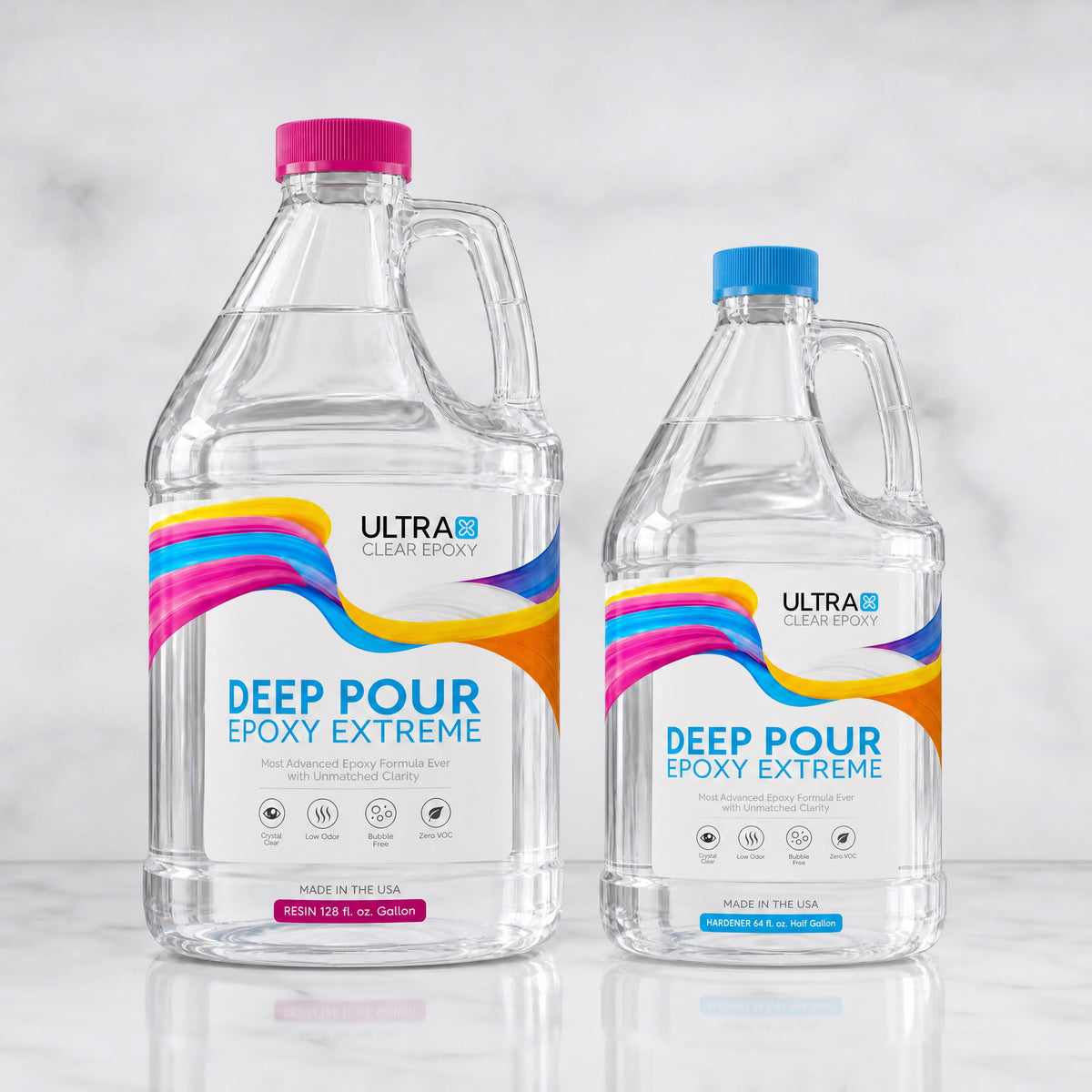
UltraClear Deep Pour Epoxy—Carefully formulated to support epoxy pours of up to 2″ thick layers at a time without overheating or developing excessive bubbles.
-
UltraClear Art & Craft Epoxy—Ideal for small pours and embedments with crystal clarity. Often used for small end tables.
All UltraClear products are 100% made in the USA under strict quality controls. They offer exceptional UV and chemical resistance, unparalleled hardness, and a consistent cure—so your tabletop stays clear, hygienic, and scratch-resistant for years.

Tips for First-Time Epoxy Users
Tip #1: Surface Prep Is Crucial
Proper sanding (120–220 grit) removes old finishes and opens the wood grain, creating a mechanical bond. Dust and debris will weaken adhesion and cause blemishes if not fully cleared with a tack cloth.
See our guide to preparing your substrate for more detailed advice.
Tip #2: Take the time to measure accurately.
Epoxy's ability to properly cure is tied to precise resin-to-hardener ratios. Measure your components with dedicated cups and mix slowly for 3–5 minutes (occasionally scraping the sides and bottom of your container) to ensure a complete blend. This will prevent soft spots or sticky areas.
Learn to avoid common measuring mistakes in this beginner-friendly explainer.
Tip #3: Control the Environment
Temperature and humidity affect viscosity and cure time. For an optimal finish, you should keep your workspace between 70–80 °F and your relative humidity below 60%. This prevents condensation (which causes cloudiness) and ensures a predictable curing schedule.
It also helps to minimize drafts and dust by sealing doors or constructing a temporary enclosure within which to perform your project under consistent conditions.
Tip #4: Before pouring a flood coat of epoxy, apply a seal coat.
A thin seal coat of UltraClear Bar & Table Top Epoxy locks in trapped air from porous wood and provides a stable base. Without it, excessive bubbles can emerge during the heavier flood coat, and the final layer may not level evenly.
See our guide to epoxy seal coats here.
Tip #5: Remove air bubbles immediately after pouring.
Air introduced during mixing will rise as bubbles. Waving a propane torch or heat gun 6–8″ above the wet surface pops bubbles when they’re easiest to eliminate. Delay risks curing them into permanent pinholes.
Tip #6: A good epoxy cure requires a little patience.
Epoxy gains strength over time. Light use at 72 hours prevents early dents; waiting 7 days for full hardness ensures maximum scratch and chemical resistance, reducing long‑term maintenance.

FAQs: Epoxy Table Top Essentials
Question #1: How thick should I pour each epoxy layer?
For standard table tops, pour UltraClear Bar & Table Top Epoxy in layers no thicker than 1/8–1/4″ to avoid overheating and bubbling. For pours up to 2″, use UltraClear Deep Pour Epoxy in staged layers.
Our article on epoxy layer thickness goes into more detail.
Question #2: What’s the ideal environment for epoxy application?
Maintain a stable temperature between 70–80°F and humidity below 60%. Dust-free, well-ventilated spaces minimize contaminants and ensure proper curing.
Question #3: How can I prevent and remove air bubbles?
For prevention: Mix your epoxy components carefully and only use a power drill (with mixing attachment) to blend large batches of about one gallon.
See our guide to mixing for proper blending techniques.
Immediately after pouring, use a heat gun or torch from a distance of 6–8″ above the resin to pop surface bubbles. For stubborn bubbles, a second pass with the same tool can help.
See our guide to removing bubbles for more advice.
Question #4: Do I need to sand between epoxy coats?
If you apply the next layer while the previous is still tacky (about 4–6 hours after applying), no sanding is required.
However, if the prior layer has started to significantly harden (about 10 hours or more), you'll need to lightly sand with 220-320 grit to provide a better bonding surface for the new layer. The scratches causes by sanding will disappear once the new layer blends with the previous one.
Question #5: How do I repair minor scratches or dull spots?
Clean the area, then buff with a fine polishing compound. For deeper marks, wet-sand gently (800–1500 grit) and apply a thin flood coat of UltraClear Bar & Table Top Epoxy.
For detailed techniques on fixing this and other issues, check out our epoxy tables repair guide.
Question #6: Can I use epoxy on outdoor table tops?
Yes, though direct sunlight can be a problem over time. Fortunately, a few precautions can help prevent yellowing and allow your finish to last longer.
Additionally, using a high-quality resin like UltraClear Bar & Table Top Epoxy can ensure a longer lifespan.
Question #7: What safety gear do I need when working with epoxy?
We recommend that you wear nitrile gloves, eye protection, and a respirator rated for organic vapors. Ensure your workspace is ventilated to disperse fumes.
Question #8: How long before I can place items on my cured epoxy table top?
Wait at least 72 hours for light use and up to 7 days for full hardness. This ensures maximum scratch resistance and chemical durability.
For more guidance on curing times and surface usability, see our guide here.

Have Questions? Want Advice? We're Here to Help!
If you have any questions about choosing the right epoxy resin for your table top, or if you'd like assistance in planning an epoxy project, please reach out to us at UltraClear Epoxy—our epoxy experts are ready to assist!
You can contact us via phone or email here. During business hours, you can also text chat online with one of our resin specialists by clicking the Help button at the bottom of your screen.
In our online store, you'll find a variety of useful tools and supplies, ideal for resin projects, plus our award-winning UltraClear Bar & Table Top Epoxy and our UltraClear Deep Pour Epoxy.